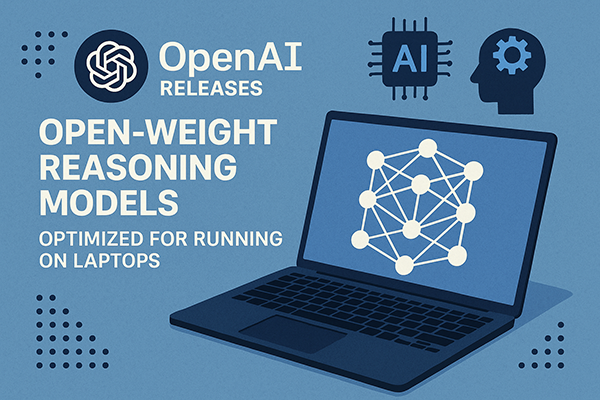
On the surface, Tuesday’s announcement from OpenAI sounds like a footnote: two new language models, released with the understated labels “120b” and “20b,” quietly uploaded to Hugging Face under the permissive Apache 2.0 license. No flashing neon billboards, no viral demos, no GPT-5 fanfare—just the weights, a modest technical paper, and a tweet. Yet the strategic tremors from this quiet drop will be felt far beyond the engineering forums. For the first time since 2019, the company that turned “AI” into a household word has put a genuinely capable reasoning engine into the commons, free to download, free to monetize, free to tinker with.
To understand why this matters to a neighborhood coffee shop or a bootstrapped SaaS startup, zoom out. For the past three years, the conversation around artificial intelligence has been dominated by one inconvenient truth: if you wanted cutting-edge performance, you paid OpenAI (or Anthropic, or Google) per token, or you signed your data away to a cloud giant. The promise of OpenAI was always “open,” but the business model quickly became a velvet rope. That arrangement worked well when the alternative was custom-building a billion-parameter neural net. It works less well when Chinese labs such as DeepSeek and Qwen release models that rival GPT-4 on half the budget and none of the gatekeeping. Washington noticed. So did developers. So did every small business that looked at ChatGPT’s price sheet and wondered how to justify the burn.
OpenAI’s answer is surgical rather than sweeping. Instead of open-sourcing the entire stack—training data, recipe, and all—the company released the weights. That means you can’t reproduce GPT-oss from scratch, but you can run it, fine-tune it, embed it in your product, and never pay OpenAI a dime. The 20b variant sits comfortably in 16 GB of RAM, which roughly translates to “your MacBook Pro after you close Slack.” The 120b variant needs one high-end GPU, still cheaper than a year of API credits at scale. Both outperform every comparable open model on code-generation leaderboards, and both can chain their thoughts through tools like web search or Python execution—perfect for automating expense reports, answering customer emails, or generating marketing copy that actually sounds like you wrote it.
The hallucination rate is higher, yes. OpenAI admits the open models hallucinate on roughly half of biographical queries, triple the rate of o1. That sounds frightening until you realize two things. First, most business use cases don’t hinge on obscure trivia about nineteenth-century poets; they hinge on structured workflows where you control the context. Second, the very openness that creates risk also creates visibility. A model you host is a model you can log, test, and patch. A black-box API that hallucinates behind a paywall is far harder to interrogate.
The geopolitical subtext is hard to ignore. Sam Altman’s statement frames the release as a bid to push “an open AI stack created in the United States, based on democratic values.” Translation: if U.S. companies don’t provide transparent, high-performance models, Chinese labs will—and they already have. The Trump administration’s quiet nudging in favor of open-source AI is less about altruism and more about export control: better to flood the global market with American weights than to cede mindshare to models whose governance is opaque. For small businesses, that ideological chess match translates into an unprecedented windfall. You are now the beneficiary of a billion-dollar R&D budget deployed to win a soft-power skirmish.
So what should you do with this sudden abundance? Start small, but start deliberately. Download gpt-oss-20b through LM Studio or Ollama and test it on a single use case that currently costs you either time or API money: summarizing support tickets, drafting contracts, generating alt text for product images. Measure latency, accuracy, and customer satisfaction for two weeks. If the numbers beat the status quo, expand. Fine-tune the model on your last twelve months of Zendesk logs or your proprietary product docs. Because the weights are open, you can iterate without legal counsel or procurement sign-offs. The Apache 2.0 license even lets you resell the tuned model as part of your own product, royalty-free.
For the more adventurous, the 120b variant opens the door to agentic workflows. Picture a Slack bot that doesn’t just answer questions but performs the follow-up: it searches your CRM, drafts the renewal email, and schedules the meeting, all without handing data to a third party. The chain-of-thought transparency means you can audit every intermediate step—a regulatory dream in healthcare, finance, or legal tech.
OpenAI insists this release is an experiment, not a pivot. But experiments have a habit of becoming infrastructure once developers start building on them. The company’s own bet is that the goodwill—and the ecosystem lock-in—will outweigh the lost revenue. Your bet, as a founder or freelancer, is simpler: that the marginal cost of intelligence just dropped by an order of magnitude, and that the first movers who harness it will rewrite their industries before the incumbents notice.
The quietest move of the week may have just given you the loudest competitive edge of the decade.
